Earlier this year, CEO RJ Scaringe addressed the topic of autonomy at the San Francisco Rivian Space opening, revealing that Rivian plans to add hands-free highway driving this year. Yesterday, during its earnings call, Rivian shared even more information, saying that their hands-free feature arriving on Gen 2 vehicles in just a few weeks.
Autonomy Light
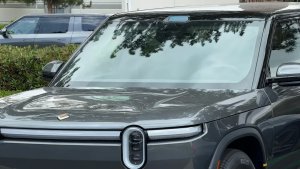
Rivian plans to leverage the light bar on their Gen 2 vehicles to show other drivers when the vehicle’s Autonomy Platform+ feature is enabled. This feature has been adopted by a few brands, including Mercedes-Benz in its Drive Pilot ADAS, and some Chinese brands as well.
Hands-Free 2025
While RJ revealed that Rivian will be launching a hands-free ADAS system this year in San Francisco, he has now added that it’s coming in the next several weeks. If you’ve used a recent version of Tesla’s Full Self-Driving (Supervised), the experience will likely feel familiar.
For those who haven’t, Rivian’s Autonomy Platform+ will enable hands-free highway driving, including automatic lane changes and exit maneuvers. However, drivers will likely need to take control upon reaching their exit—more on that later.
Similar to Tesla, while the driver is hands-free, attention to the road is required. Rivian’s Driver Monitoring System (DMS) ensures this by combining seat weight sensors with a camera embedded in the rearview mirror.
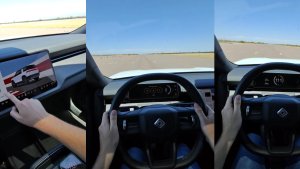
This is the video Rivian uses to demonstrate the Rivian Autonomy Platform+ (RAP+) capability called Enhanced Highway Assist. See the cars icon slide out up by the speed bubble? I wonder what they're trying to showcase here... pic.twitter.com/YZv3rjZtmH
The most interesting part of the announcement was that Rivian plans to launch an “eyes-off” system in 2026. That means that you won’t need to keep an eye on your vehicle as it navigates the highways - you’ll be able to take your eyes off the road, send some texts from your phone, and perhaps watch a movie or play a game on your center display.
The DMS will be disabled, and you’ll only be notified if you need to take over.
Highways or Streets?
Rivian has previously indicated that its autonomy efforts are focused on highways rather than the complexities of city streets. RJ Scaringe didn’t specify whether Rivian plans to expand beyond highway driving.
Highways are significantly easier to navigate than urban environments, so it’s reasonable to assume that the upcoming features and timelines will apply to Platform+ on highways—the only place Rivian originally intended for hands-free operation.
This means the system will handle driving from on-ramp to off-ramp, making long highway commutes and road trips far easier and more enjoyable.
Gen 2 Only
Unfortunately for early adopters, these improvements are exclusive to the Autonomy Platform+, which means that they won’t apply to any Gen 1 vehicles built before 2025.
Free Trial & Price
Rivian also shared that all Gen 2 owners will receive a free trial that includes these new features, hinting that they may soon start charging for their ADAS. Rivian has yet to announce pricing for their Autonomy Platform+ features, but to remain competitive we expect them to be similar to Tesla’s. Tesla currently costs $8,000 to buy FSD or $100 per month to subscribe to the service.
Liability
Liability is a major question when it comes to autonomy. While Rivian’s hands-free system will undoubtedly hold the driver responsible, the stakes change with an eyes-off system. Who assumes liability when the vehicle is fully autonomous? Will it be Rivian, or does responsibility still fall on the driver?
In Germany, Mercedes-Benz takes full liability when Drive Pilot is engaged within its strict operating conditions. As ADAS systems push closer to fully autonomous capabilities—Tesla’s FSD included—these questions become even more critical.
Regardless, 2025 is shaping up to be an exciting year for Rivian with the launch of the hands-off feature many drivers have been waiting for. We’re eager to see how it performs and what other innovations Rivian has in store.
Subscribe
Subscribe to our newsletter to stay up to date on the latest Rivian news, upcoming features and software updates.
Rivian is officially making its extreme performance ambitions known with the launch of the Rivian Adventure Department, or RAD, for short. What began as a quiet, internal skunkworks team of dedicated designers and engineers has now been formalized into a specialized division tasked with pushing Rivian’s vehicles to their absolute limits.
RAD becomes essentially an AMG, ///M, or GT equivalent inside of @Rivian.
Sounds like we can expect future models to carry the RAD name as a trim level. Think “R1T RAD” perhaps.
By validating the hardware and software in some of the most unforgiving environments on Earth, RAD aims to translate some of the lessons learned from high-performance motorsports directly into exciting consumer features.
From the Desert to Pikes Peak
The roots of the RAD initiative trace back to Rivian’s earliest days, including the grueling 13,000-mile prototype journey from Patagonia to Los Angeles during the filming of the Long Way Up documentary. Since then, the internal passion project has evolved through rigorous real-world motorsport testing.
When a Rivian R1T became the first EV to win the gruelling Rebelle Rally in 2023, the data gathered from conquering the deep sand directly led to the development of Rivian’s Desert Rally drive mode, as well as the Deep Sand mode.
Our team is further developing the deep sand performance of the Tri-Motor R1! It’s incredible :) pic.twitter.com/DNzlGaSVAH
Similarly, when Rivian’s engineers set out to shatter the production electric truck record at the Pikes Peak International Hill Climb, they built a custom internal software tool to adjust torque bias, stability control, and regenerative braking on the fly. They realized one thing along the way: that tool was simply too fun to keep locked away for engineers, and Rivian decided to refine it for customers, too.
The RAD Tuner
That Pikes Peak engineering tool has officially arrived in consumer vehicles as the RAD Tuner. Exclusively available for Gen 2 Quad-Motor owners, the RAD Tuner acts as a high-performance equalizer for the powertrain.
You have access to real-time control over ten different vehicle parameters, including power output, front-to-rear torque split, brake assistance, wheel slip, damping, and roll stiffness. Instead of relying on factory presets, off-road enthusiasts can now dial in their own custom driving dynamics to suit their style and the trails they’re adventuring on.
That’s a level of customizability that’s never really been available in a production vehicle before.
Taking on the FAT Ice Course
To celebrate the formalization of the new division, RAD is making its official public debut this week at the 2026 FAT Ice Race in Big Sky, Montana. They’re also showcasing the new bold orange, red, and white RAD livery - and competing with a brand-new Quad-Motor R1S on the frozen course.
Rivian R1S Quad on studded tires sets a lap around the FAT Ice Race course!
The studded tires help a ton but so does the new RAD Tuner that allows Luke Lynch to dial in all of the suspension and powertrain attributes to his liking
Equipped with studded tires, the first R1S Quad RAD is leveraging RAD Tuner to perfectly control its suspension and powertrain for the low-traction environment - all with 1,025 horsepower on tap. Perfect torque delivery is what keeps a vehicle stable at those speeds and in those conditions, and Rivian is proving that its new performance division isn’t just a marketing exercise - it is a massive commitment to build highly performing electric adventure vehicles.
Skiers at Big Sky Resort in Montana are getting a high-tech lift to the slopes this season that does not involve a gondola. X user Kyle Conner (@itskyleconner) recently shared footage of a fleet of at least six Rivian R1T trucks being used as a specialized shuttle service at the resort.
"6 Rivian R1Ts pulling trailers to move people around Big Sky ski area. So cool!" Conner noted while capturing the electric trucks in action. The implementation is a clever way to solve a common mountain problem: getting people from free parking zones to the ski lifts without forcing them to hike up in heavy gear.
The setup involves the R1T trucks pulling large trailers or carts, each capable of seating more than a dozen people. According to Conner, the shuttle service runs daily from 8:30 a.m. to 6 p.m., effortlessly moving crowds across the ski zone.
It appears that Rivian may have provided both the trucks and the custom trailers to the resort for this specific pilot program. When the sun goes down and the slopes close, the fleet is parked at on-site Level 2 AC chargers to juice up for the next day. Seeing these silent, emission-free pickups replace noisy diesel shuttles is a major win for sustainable mobility in fragile mountain ecosystems.
6 Rivian R1Ts pulling trailers to move people around Big Sky ski area. So cool! pic.twitter.com/l3xIDNuiQa
The R1T is practically overqualified for this job. The Gen 2 (2025–2026) model is a high-performance beast, with the Quad-Motor variant pushing a staggering 1,025 hp and 1,198 lb-ft of torque. It can hit 0–60 mph in just 2.5 seconds, and the Dual Max version offers a massive EPA-estimated range of 420 miles.
More importantly for a ski resort, the R1T features 14.9 inches of ground clearance and advanced off-road capabilities that make navigating icy, snowy roads a breeze. With a max towing capacity of 11,000 lbs, pulling a cart filled with skiers is light work for this truck. Safety is also a major factor, as the R1T is the only EV ever to achieve an IIHS Top Safety Pick+ rating in the pickup category.
The Future of the Brand
This mountain implementation comes at an exciting time for Rivian. While the R1T and R1S continue to prove their worth in extreme conditions, the company is finally nearing the launch of its long-awaited R2 midsize SUV.
The Big Sky implementation is pretty impressive. By putting their hardware into real-world, high-utility roles like this, Rivian is showing that electric trucks are not just for the suburbs — they are rugged enough to keep a world-class ski resort running smoothly and sustainably.