Rivian is taking one of its most helpful accessibility features and giving it a massive overhaul. In a recent post on X, Rivian’s Chief Software Officer Wassym Bensaid announced that the upcoming 2026.03 software update will completely revamp "Kneel Mode" for both first and second-generation R1 vehicles.
Bensaid noted that these improvements were refined based on user feedback, specifically thanking users like tech YouTuber JerryRigEverything and his partner Cambry for their input. While we don't have an exact release date yet, this update will follow the v2025.46 release from December, which brought major autonomy upgrades like Universal Hands-Free driving.
What is Kneel Mode?
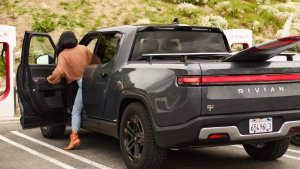
If you’re new to the brand, Kneel Mode is a handy feature available for both the R1T pickup and R1S SUV. Originally released in October 2022, it uses the vehicle’s independent air suspension to lower the ride height when you park. The goal is simple: make it easier for people and pets to hop in and out, and make loading gear into the front trunk or rear cargo area less of a chore.
Currently, when the mode is toggled on, the car drops about 1.4 inches (35mm) within five seconds of shifting into park. To keep things safe, it only works in "All-Purpose" and "Conserve" modes at a standard ride height. It won't activate if you’re in Off-Road or Towing modes, as a sudden height change could damage the underbody or your trailer.
If someone opens a door before the car finishes lowering, the process pauses until everyone is out and the doors are shut. Once you start driving again, the car automatically raises back up to its standard height as you hit 5 mph.
What’s Changing in the 2026.03 Update?
The upcoming revamp makes the feature much more flexible. According to Bensaid, the R1 can now go even lower than before, providing a truly "lower profile" for entry and exit.
One of the biggest usability upgrades is a quick control option, which adds a dedicated button to the user interface for one-tap access to Kneel Mode.
Rivian is also releasing what they’re calling a rolling trigger, which sounds like it allow the user to enable Kneel Mode on Park if the vehicle is traveling below 20 mph.
Perhaps most importantly, Rivian is expanding where you can use it. The updated Kneel Mode will be available across many different ride heights and all on-road drive modes — including Sport Mode, which previously didn't support it because the car was already low. It even gets a boost for adventuring, staying active on 15% grades and 25% side tilts.
These changes will make the once-niche setting into a much more useful setting that works when and where you actually need it.

Subscribe
Subscribe to our newsletter to stay up to date on the latest Rivian news, upcoming features and software updates.
The moment Rivian fans have been waiting for is almost here. This Thursday, March 12, the California-based automaker will officially take the stage at SXSW 2026 in Austin, Texas, to unveil the production version of its highly anticipated R2 midsize SUV.
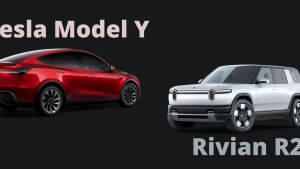
The R2 represents a make-or-break moment for the brand. Rivian is banking on this vehicle and its new autonomy stack to lead it to profitability by the end of 2026. Built on an entirely new, lighter platform, the R2 is designed to compete directly with the Tesla Model Y.
What to Expect
Based on insights from Rivian watcher @Hilbe, we have a solid idea of what to expect from the reveal. The highlight will be the automaker sharing the full specifications for the R2 and what variants it will be available in, along with the configurator launch, where we should see options for paint, wheels, and interior finishes.
Launch Configurations: The first trim to roll off the line is expected to be the dual-motor, all-wheel drive Launch Edition.
Pricing: While the R2 is rumored to start around $45,000 for the single-motor base model, the Launch Edition that’s supposed to kick off deliveries will likely carry a higher price tag.
Performance & Upgrades: Expect details on a performance upgrade for the 656-horsepower dual-motor setup, which hits 0-60 mph in 3.5 seconds. There should also be an "All-Terrain" package and premium audio options.
Utility Features: Look for more info on the rear window that rolls into the tailgate and front seats that fold flat for car camping.
Tesla Compatibility: The R2 will feature a native NACS port, granting it access to Tesla Superchargers out of the box.
Rivian Wave
While the hype is high, there are some things you shouldn't count on seeing this Thursday. We aren't expecting immediate R2 deliveries, as volume production in Illinois isn't slated until mid-2026.
Additionally, don't expect current reservations to convert to firm orders just yet, nor should you expect R2 accessories to hit Rivian’s Gear Shop immediately. While the focus is strictly on the R2, Rivian could always surprise us with new glimpses of the R3 or R3X, though new models like an "R2T" or "R1X" remain unlikely for this specific event.
When is the Event
The R2 unveiling is scheduled for Thursday, March 12, 2026. This date is strategically chosen to pre-empt the start of Rivian's "Electric Roadhouse" showcase at SXSW, where the company will later offer public R2 rides to attendees.
The event is expected to start at 9:30 a.m. PT, which is the following times around the world:
9:30 a.m. Pacific Time
12:30 p.m. Eastern Time
4:30 p.m. UTC
4:30 p.m. — London, England
5:30 p.m. — Berlin, Germany
3:30 a.m. (next day) — Sydney, Australia
How to Watch
Rivian is expected to livestream the event directly from its SXSW hub in Austin. The company typically shares a link on its social media channels and website closer to the start time. We will add that link here as soon as it becomes available, so stay tuned for that and our full coverage of the R2 unveiling.
This event marks the beginning of Rivian's transition from a niche, high-end truck maker to a mass-market player. If the R2 lives up to the specs we've seen so far, the electric SUV market is about to get a lot more interesting.
Rivian has laid out a highly aggressive roadmap for the next chapter of its business. Presenting at the Morgan Stanley Technology, Media & Telecom Conference on Thursday, Rivian’s executives detailed their strategic vision moving forward, focusing on the R2 platform, autonomous driving, and the financial runway provided by the Volkswagen Joint Venture.
While Rivian acknowledged the ongoing challenges of managing production costs and scaling internationally, the tone of the presentation was overwhelmingly focused on leveraging software and technology to reach profitability by the end of 2026.
R2 for Next-Gen
The R2 platform is the linchpin of Rivian's growth strategy. Designed to tackle a much larger, more affordable addressable market than the flagship R1 lineup, executives noted that capturing even a fraction of the market share they achieved with the R1 in this new segment would be a "home run beyond our wildest dreams.”
However, the R2 is more than just a smaller vehicle entering the lineup. Rivian described the new platform as a vessel for its advanced technology. It represents the company's next-generation electrical architecture and software stack, which is critical for the scale and profitability they’re looking for. This mid-size platform will also be the focus of Rivian's new plant in Georgia, which is intended to facilitate future exports to the European market.
Building Its Own Hardware
Perhaps the most significant change discussed during the conference was Rivian's dedication to developing its autonomous driving platform entirely in-house. Rather than relying on external suppliers or off-the-shelf software as it has done so far, Rivian is aggressively building its own autonomy stack to differentiate itself from other automakers.
Unlike Tesla, Rivian’s vehicles will be boasting a robust sensor suite, with Gen 2 vehicles equipped with 11 cameras, five radars, and upcoming LiDAR hardware in later revisions. By pulling driving data from these highly equipped customer vehicles, Rivian believes it has created a fleet capable of effectively gathering ground truth data in the real world.
Following the launch of hands-free RAP+ early last year, Rivian confirmed plans to introduce a highly advanced point-to-point autonomous system later this year.
Licensing Autonomy
This massive investment in electrical architecture and autonomy is not just for Rivian's own vehicles. Rivian is instead looking to be viewed as a modern technology provider for the automotive industry.
This strategy was validated by the $5.8 billion joint venture with the Volkswagen Group. Rivian sees a major opportunity to potentially license its autonomous hardware and software capabilities, in addition to its zonal electrical architecture, to other automakers that are struggling to keep pace with the transition to software-defined vehicles.
Financial Runway
To fund these ambitious technological leaps, Rivian appears to be on a stable financial footing. The company ended 2025 with $6.1 billion in cash reserves and anticipates an additional $2 billion infusion from Volkswagen during 2026. With the upcoming R2 launch, expanding tech partnerships, and a strict focus on cost reductions, Rivian executives reaffirmed their goal to achieve positive gross profit margins by the end of 2026.
This contrasts with recent analyst expectations from Bank of America, which has noted that Rivian is running on a tight financial leash to meet all its capital expenditures around the R2 and autonomy.