Rivian is getting ready to launch its most important vehicle to date, and as we get closer to the first deliveries, we are starting to see the clever design details that set the R2 apart. While most of the hype has been around its price and “Drop Glass” rear window, the vehicle's front trunk (frunk) is proving to be a standout feature for everyday usability.
According to automotive content creator JoshWest247, who recently got hands-on with the SUV at SXSW 2026, the frunk was a major focus for Rivian’s design team. Jeff Hammud, Rivian's chief designer, intentionally kept the front end a bit taller to maximize practical storage. "Whether you're a weekend warrior or you're out in the woods or just hauling stuff through the city, we've got a huge amount of additional storage space here," West noted in his deep dive.
Size and Capacity
Rivian’s goal for the R2 was to create a vehicle that can haul a family’s worth of gear without the massive footprint of the R1S. The company estimates that between the frunk and the rear cargo area, you can fit five suitcases, three backpacks, and a stroller.
Rivian Wave
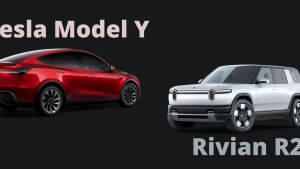
Rivian states that the R2 frunk offers 5.2 cu-ft (147 liters) of capacity. For comparison, that’s much smaller than the R1S frunk (11.1 cu-ft), but larger than the frunk found on Tesla’s Model Y at 4.1 cu-ft (compare R2 to Model Y).
Based on those numbers, the rough dimensions of the storage tub are approximately 52" wide by 18" long and 12" deep. The shape is a clean, deep rectangle that makes it perfect for grocery bags or a standard carry-on suitcase.
Opening and Closing
Unlike the trunk, the R2 frunk isn't fully "powered" in the sense that a motor lifts and lowers it like a garage door, but it feels remarkably close. It uses a power release system — you simply press a capacitive button marked with three lines on the outside of the vehicle to unlatch it, and the hood lifts open automatically. This allows you to drop your bags inside even when your hands are mostly full. There’s also an emergency open button on the inside of the frunk for safety.
Rivian Wave
For closing, Rivian has implemented a soft-close mechanism. You can lower the hood (even with a single finger) until it reaches the latch; at that point, the car takes over and "sucks" the hood down to a secure seal. You can also open the frunk remotely via the Rivian mobile app or through a button on the internal screen.
Rivian could eventually also add a hands-free "auto-open" feature for the frunk and trunk using Ultra-Wideband (UWB) technology, similar to what Tesla offers. This would allow the frunk to pop open automatically as you approach with your phone in your pocket, making the space even more convenient.
Evolution from Prototype to Production
Comparing the production-intent design to the early prototype we saw back in 2024 reveals some smart refinements. One of the most obvious changes is the windshield washer fluid fill, which has been moved from the rear of the bay to the very front passenger side. This ensures you don't have to lean over a potentially dirty car to top up your fluids.
The frunk on an R2 prototype from 2024
Rivian Wave
Rivian also cleaned up the interior aesthetic by removing the embossed logo from the topside inner lining and adding a replaceable protective material. This liner acts as a buffer, preventing cargo from scuffing the hood when it vibrates against the inside of the frunk during off-road adventures.
A Truncated Timeline for the R2 Family
Rivian is currently preparing for a phased rollout of the R2, and the good news is that this well-designed frunk should be standard across the entire lineup. The journey begins later this spring with the R2 Performance. This $57,990 flagship features dual-motor AWD, a 3.6-second 0–60 mph time, and an exclusive Launch Package for early reservation holders.
Rivian Wave
The rest of the family will follow through 2027:
R2 Premium ($53,990): Arriving late 2026.
R2 Standard Long Range ($48,490): Expected in early 2027 with a lineup-defining 345-mile range.
R2 Standard ($45,000): The base model, anticipated for late 2027.
The R2 launch is critical for Rivian’s bottom line as it moves toward the mass market. By focusing on practical features like a hands-free opening frunk and easy-access washer fluid reservoirs, the company is making a strong case for itself against established competitors.
If you want to see the frunk in person, Rivian is taking the R2 on a nationwide tour with "Block Party" events in cities like Venice, Denver, and Chicago. It is a great opportunity to see if this "new standard" for storage lives up to the hype before the first Performance units hit the driveway this spring.
Subscribe
Subscribe to our newsletter to stay up to date on the latest Rivian news, upcoming features and software updates.
As Rivian prepares for its biggest production ramp yet, the company is quietly building out the executive team needed to support a massive influx of new owners. A recent move to fill two high-level leadership positions signals that major updates are on the horizon for both Rivian Insurance and Rivian Care, the company’s in-house protection programs.
The expansion was first highlighted by Rivian enthusiast Chris Hilbert (@Hilbe), who shared a call for talent from Mike Slattery, Rivian’s Head of Insurance. Slattery’s announcement makes it clear that the company is looking to move beyond "business as usual" by leveraging its connected vehicle platform to rethink how insurance and warranties work.
Building a "High-Impact" Support Engine
The first of the two roles, the Sr. Program Operations Lead for Rivian Care, will serve as the "operational engine" behind the company’s vehicle protection products. This includes scaling high-impact programs like service contracts, windshield protection, and wheel and tire plans across multiple markets.
Currently, Rivian — whose name reflects a focus on the adventurous spirit of the Indian River — offers Rivian Care as a pilot program powered by Assurant. It is designed to protect vehicles like the R1T and R1S beyond their standard manufacturer’s warranty, covering critical components like the high-voltage battery and drivetrain. With a dedicated operations lead now joining the team, it’s likely that this pilot phase is nearing an end in favor of a more robust, permanent program.
The Future of Connected Insurance
The second position is an Insurance Agency Leader based on the ground at Rivian’s manufacturing hub in Bloomington/Normal, Illinois. Slattery noted that this leader will be tasked with driving profitability while keeping the owner experience central, all while "leveraging vehicle intelligence to fundamentally change how vehicle protection products actually work!"
Rivian Insurance is already a licensed agency available in all 50 U.S. states, but its potential is only just being tapped. Much like Tesla Insurance, which recently released its Safety Score 3.0 to further reward drivers who use the company’s Full Self-Driving (Supervised) system, Rivian is looking to use data-driven rates via its Driver+ system. By using the vehicle’s internal intelligence, Rivian can offer custom policies tailored to the exact risk profile of its drivers, making the transition from R1 to the mass market much smoother.
A mass-market vehicle brings a much broader audience, many of whom will expect first-party extended warranties and competitive insurance rates right out of the box. By scaling these leadership roles now, Rivian is ensuring it has the "operational engine" ready to handle tens of thousands of new R2 owners. This proactive hiring suggests that when the R2 configurator opens later this year, it will likely be accompanied by a more integrated and transparent suite of protection products than ever before.
Rivian is taking a major step toward closing the loop on battery life. The electric vehicle maker has officially announced a partnership with Redwood Materials to deploy a first-of-its-kind energy storage system at its Normal, Illinois, manufacturing facility. By repurposing more than 100 "second-life" battery packs from its vehicles, Rivian will create a 10 megawatt-hour (MWh) storage reservoir to help power the very plant where its cars are built.
This partnership is a massive win for sustainability. EV batteries are designed to be incredibly durable, often outlasting the vehicles themselves. Even when a pack is no longer ideal for high-performance driving, it still holds significant value for stationary storage. By utilizing these assets, Rivian is ensuring its environmental footprint remains as small as possible.
Repurposing for the R2 Ramp
The timing of this installation is particularly critical. Rivian’s Normal plant is currently gearing up for mass production of the R2, the company’s first affordable, mass-market SUV. After recently beating Q1 delivery estimates, the factory is under immense pressure to scale.
Rivian Wave
The new 10 MWh system will provide "dispatchable energy," meaning Rivian can pull power from these batteries during peak demand periods. This will not only lower energy costs for the company but also reduce the overall load on the local electrical grid, supporting reliability for the surrounding community.
“EVs represent a massive, distributed and highly competitive energy resource,” said Rivian Founder and CEO RJ Scaringe. “As energy needs grow, our grid needs to be flexible, secure, and affordable. Our partnership with Redwood enables us to utilize our vehicle’s batteries beyond the life of a vehicle and contribute to grid health and American competitiveness.”
Solving the Industrial Growth Constraint
The "secret sauce" behind this setup is Redwood’s proprietary Pack Manager technology. This system acts as a universal translator, allowing Redwood to communicate with and control different battery packs regardless of their original voltage or state of health.
JB Straubel, the founder and CEO of Redwood Materials (and former Tesla CTO), highlighted that the grid is currently struggling to keep up with the demands of modern manufacturing. “Electricity demand is accelerating faster than the grid can expand, posing a constraint on industrial growth,” Straubel said. “Our partnership with Rivian shows how EV battery packs can be turned into dispatchable energy resources, bringing new capacity online quickly, supporting critical manufacturing, and reducing strain on the grid without waiting years for new infrastructure. This is a scalable model for how we add meaningful energy capacity in the near term.”
A Scalable Model for the Future
This 10 MWh project is just the beginning. Redwood estimates that by 2030, the U.S. will need over 600 GWh of storage to stabilize the grid — a massive amount of energy equivalent to the Hoover Dam running for two months straight.
By turning old EV batteries into stationary assets before they are eventually recycled, companies can defer billions of dollars in costly infrastructure upgrades. As Rivian prepares to hand over the first R2 keys later this spring, its factory will be running on a smarter, more resilient energy loop that proves the "second life" of a battery is just as important as the first.