Rivian Targets Profitability by End of 2026, Betting on R2, Autonomy and Licensing

By Karan Singh
Rivian Wave

Rivian has laid out a highly aggressive roadmap for the next chapter of its business. Presenting at the Morgan Stanley Technology, Media & Telecom Conference on Thursday, Rivian’s executives detailed their strategic vision moving forward, focusing on the R2 platform, autonomous driving, and the financial runway provided by the Volkswagen Joint Venture.

While Rivian acknowledged the ongoing challenges of managing production costs and scaling internationally, the tone of the presentation was overwhelmingly focused on leveraging software and technology to reach profitability by the end of 2026.

R2 for Next-Gen

The R2 platform is the linchpin of Rivian's growth strategy. Designed to tackle a much larger, more affordable addressable market than the flagship R1 lineup, executives noted that capturing even a fraction of the market share they achieved with the R1 in this new segment would be a "home run beyond our wildest dreams.”

However, the R2 is more than just a smaller vehicle entering the lineup. Rivian described the new platform as a vessel for its advanced technology. It represents the company's next-generation electrical architecture and software stack, which is critical for the scale and profitability they’re looking for. This mid-size platform will also be the focus of Rivian's new plant in Georgia, which is intended to facilitate future exports to the European market.

Building Its Own Hardware

Perhaps the most significant change discussed during the conference was Rivian's dedication to developing its autonomous driving platform entirely in-house. Rather than relying on external suppliers or off-the-shelf software as it has done so far, Rivian is aggressively building its own autonomy stack to differentiate itself from other automakers.

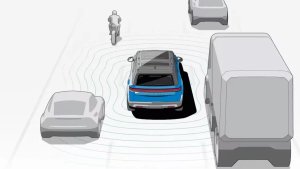
Unlike Tesla, Rivian’s vehicles will be boasting a robust sensor suite, with Gen 2 vehicles equipped with 11 cameras, five radars, and upcoming LiDAR hardware in later revisions. By pulling driving data from these highly equipped customer vehicles, Rivian believes it has created a fleet capable of effectively gathering ground truth data in the real world.

Following the launch of hands-free RAP+ early last year, Rivian confirmed plans to introduce a highly advanced point-to-point autonomous system later this year.

Licensing Autonomy

This massive investment in electrical architecture and autonomy is not just for Rivian's own vehicles. Rivian is instead looking to be viewed as a modern technology provider for the automotive industry.

This strategy was validated by the $5.8 billion joint venture with the Volkswagen Group. Rivian sees a major opportunity to potentially license its autonomous hardware and software capabilities, in addition to its zonal electrical architecture, to other automakers that are struggling to keep pace with the transition to software-defined vehicles.

Financial Runway

To fund these ambitious technological leaps, Rivian appears to be on a stable financial footing. The company ended 2025 with $6.1 billion in cash reserves and anticipates an additional $2 billion infusion from Volkswagen during 2026. With the upcoming R2 launch, expanding tech partnerships, and a strict focus on cost reductions, Rivian executives reaffirmed their goal to achieve positive gross profit margins by the end of 2026.

This contrasts with recent analyst expectations from Bank of America, which has noted that Rivian is running on a tight financial leash to meet all its capital expenditures around the R2 and autonomy.

Rivian Continues to Convert RAN Chargers to NACS

By Nehal Malik
@RivianUpdates

Rivian is making steady progress in its mission to unify the electric vehicle charging experience across North America. The company is actively retrofitting its proprietary DC fast-charging infrastructure, known as the Rivian Adventure Network (RAN), to replace aging CCS connectors with Tesla’s North American Charging Standard (NACS).

As pointed out by @AlejandroEV66, recent data shows that at least 23 Rivian Adventure Network sites — roughly 16% of the entire network — have now been retrofitted with NACS connectors. This means EV drivers with NACS ports can simply plug in without needing a bulky adapter. You can even track the progress yourself through a live list of NACS-equipped RAN sites to see which locations have made the switch.

The Shift to the North American Charging Standard

Rivian’s journey toward NACS began back in 2023 when the company officially joined the growing list of automakers adopting Tesla’s connector. At the time, Rivian Founder and CEO RJ Scaringe said, "We’re excited to work with Tesla and to see collaborations like this help advance the world toward carbon neutrality. The adoption of the North American Charging Standard will enable our existing and future customers to leverage Tesla’s expansive Supercharger network while we continue to build out our Rivian Adventure Network."

As part of this commitment, Rivian announced that all R1 vehicles from 2025 onwards would be equipped with native NACS ports. This transition also paved the way for the long-awaited R2 midsize SUV, which is built on a completely new platform and will feature a built-in NACS port when it launches later this month. The R2 is also expected to be a tech powerhouse, utilizing next-generation eSIM technology for constant connectivity.

Converting the Adventure Network

While Rivian owners have already gained access to Tesla’s massive Supercharger network, the company is still focused on its own branded charging experience. Reports from the field, such as those from @RivianUpdates, show that stations are being converted overnight. In one instance, a station that was entirely CCS1 one day had four of its fourteen stalls converted to NACS by the next.

@RivianUpdates

This retrofitting process is crucial for the company's future. By equipping its own stations with NACS, Rivian ensures that its newest vehicles — and those from other manufacturers like Ford or GM — can charge seamlessly. While the company is also exploring wireless charging to potentially eliminate ports altogether in the future, the immediate focus is clearly on standardizing the plug-in experience.

A More Convenient Future

Standardizing on NACS is a win for everyone. It reduces the "range anxiety" often felt by new EV owners and simplifies the hardware needed in the vehicle. As more RAN sites come online with the new connectors, the distinction between "Tesla charging" and "everyone else" will continue to fade.

Rivian is positioning itself as a leader in this transition, ensuring that whether you’re driving an original R1T or the upcoming R2, finding a fast, reliable charge is easier than ever.

Rivian R2 Will Use Next-Generation eSIM and AT&T for U.S. Connectivity

By Karan Singh
Rivian Wave

Rivian’s highly anticipated R2 just picked up another quiet but meaningful technological win ahead of its full pricing and configurator reveal (R2 specs). Rivian is doubling down on ensuring parts commonality between the initial version destined for North America and future versions destined for Europe and the Asia-Pacific markets by integrating next-gen eSIM hardware.

Rivian has announced it is collaborating with the Munich-based firm Giesecke+Devrient (G+D) and AT&T in North America to equip the R2 with this tech that’s currently available on modern flagship devices.

With this partnership, the R2 will be one of the first vehicles in the world to launch with GSMA SGP.32-enabled eSIM technology and 5G connectivity out of the box. While cellular hardware updates rarely make front-page headlines, this specific integration is a massive win for Rivian.

The Power of SGP.32

To understand why this matters, just think about the logistical nightmare legacy manufacturers face when selling connected cars internationally. Manufacturers generally need to manage multiple hardware variants to accommodate the specific cellular networks available in various countries.

The newly finalized SGP.32 eSIM standard, built specifically for automotive and IoT applications, eliminates that friction and simplifies standardization. This architecture allows Rivian to utilize a single global hardware SKU, meaning that as the R2 expands into new international markets, no new hardware is required.

Rivian can seamlessly add or swap Mobile Network Operator (MNO) partners entirely over the air, without ever needing to touch the physical hardware inside the vehicle. For a company that is actively scaling its operations and looking to push the R2 into markets outside of North America, this remote management infrastructure is a game-changer. 

The AT&T Connection

While G+D is providing the eSIM hardware and remote management capabilities, AT&T will serve as Rivian’s initial mobile network provider in the United States. AT&T’s 5G network will power the R2’s connected services, from streaming entertainment to local hotspotting and navigation.

Software-Defined Vehicle

Ultimately, the R2 is designed to be a software-defined vehicle that constantly improves throughout its lifecycle. That means its connectivity must function everywhere, no matter what country it's sold in.

Simplifying the parts pipeline from dozens of regional SKUs to just a single global part makes vehicle assembly incredibly simple and helps to future-proof before volume production begins.

Latest Rivian Update