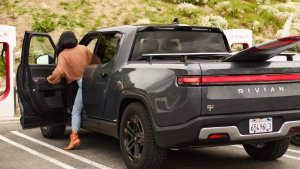
With unique vehicles also come unique engineering challenges, and the Rivian R1S and R1T are no exception. The US National Highway Traffic Safety Administration (NHTSA) has initiated a preliminary investigation into 114,922 Rivian vehicles. The probe targets a critical component of the rear suspension: the rear toe link assembly.
While a preliminary evaluation is not a formal recall, it’s the first phase of regulatory discovery, focusing on whether a vehicle's structural components can withstand road and service conditions.
Toe Link Separation
The depth of the investigation is seen in the vehicle owner questionnaires (VOQs) submitted to NHTSA’s Office of Defects Investigation. The federal agency opened the probe after receiving two separate reports detailing a complete separation of the left rear toe link while the vehicles were in motion.
From an engineering perspective, the rear toe link is a stabilizing geometry component that controls the horizontal alignment, or toe angle, of the rear wheels. When a toe link separates at highway speeds, the affected wheel loses its directional constraint, pivoting freely under the vehicle's immense torque and mass.
In layman’s terms, that means an immediate loss of control of the vehicle. According to NHTSA documentation, the reported failures caused the vehicles to swerve unpredictably across multiple lanes of traffic. One of the recorded incidents escalated into a multi-impact collision, with the vehicle striking both an adjacent automobile and a roadside barrier.
The severity of these incidents is what has prompted an expansive federal investigation after just two consumer complaints.
Rivian’s Defense
In an official statement, Rivian asserted that its internal data indicates the R1 platform's toe link joints are operating precisely as intended under normal engineering parameters.
Rivian suggests that the issues may stem from improper past service, environmental anomalies, or fastening errors rather than a fundamental flaw in the suspension design.
The January Recall
In January of this year, Rivian issued a voluntary recall for nearly 20,000 previously serviced R1S and R1T electric vehicles in the United States, citing an issue in which the rear toe link bolts were incorrectly assembled during service.
During those initial campaigns, the NHTSA noted that the primary remedy required Rivian service technicians to inspect and replace the rear toe link fastening hardware free of charge.
A primary mandate of NHTSA's current probe will involve an audit of Rivian’s service manual and repair procedures. Investigators are seeking to determine whether the vulnerabilities are resolved by the bolt-replacement protocol or whether the underlying suspension geometry remains sensitive to real-world operational stress.
Follow Us on Google
Add Rivian Wave as a preferred source on Google to see more of our stories in Top Stories.
Add to Preferred Sources