Rivian’s R2: Specs and How it Compares to Tesla's Model Y

By Karan Singh
Rivian

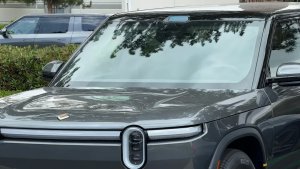
After months of anticipation, the Rivian R2 has finally hit the pavement. Recent media drives and soft-launch previews have given us our first tangible look at the midsize SUV that Rivian hopes will redefine the mass-market EV landscape.

While it looks remarkably similar to its larger sibling, the R1S, the R2 is built on an entirely new architecture. It is smaller, substantially lighter, and packed with thoughtful interior utility. 

Let’s take a look at everything we’ve seen so far about the R2 as Rivian continues to gear up for volume production.

R2 Specs

The R2 is stepping into the highly competitive midsize crossover segment, directly competing with some of the best-selling vehicles in the world, including the Tesla Model Y and the Toyota RAV4.

By shifting from the R1’s heavy body-on-frame architecture to a new, simplified unibody platform, Rivian has shaved roughly 2,000 pounds off the vehicle’s weight. Those savings translate into a significant increase in efficiency and performance.

The launch-edition Dual-Motor AWD prototypes boast 656 horsepower, along with 609 lb-ft of torque. All of that is backed by a 400V architecture, with an 87.4kWh battery on Rivian’s new 4695 cell format, delivering 0-60 mph in just 3.5 seconds.

Rivian Wave

Of course, the future Tri-Motor variant is expected to drop the 0-60 down below 3 seconds for even more performance, but it will likely be some time before that actually arrives.

Charging is supported with a native NACS charge port, capable of charging from 10% to 80% SoC in approximately 30 minutes. While that charge rate isn’t industry-leading, it is comparable to that of its most direct competitor, the Model Y.

Just like the R1S and R1T, the R2 is designed as an adventure vehicle. That means a flat bottom, dedicated off-road driving modes, and a stock 9-6 inches of ground clearance, which is best-in-class. Rather than an air suspension, the R2 uses a simpler multi-link suspension that’s far easier to produce and less bouncy. If you want to take an EV off-road, the R2 will be a fantastic option, just like its bigger brothers.

Comparing it to the Model Y

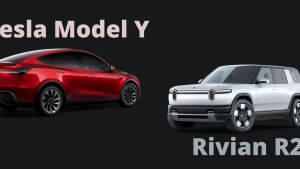
For many shoppers, the Model Y Premium AWD is the primary competitor against the Rivian R2, so we’ve built a simple comparison table to help you look at both at a quick glance.

Specification

Rivian R2 (Dual-Motor Launch Edition)

Tesla Model Y (Premium AWD)

0–60 mph Acceleration

3.5 seconds

4.6 seconds

Power Output

656 hp / 609 lb-ft

~425 hp / 475 lb-ft

Estimated Range

300+ miles

327 miles

Dimensions (L x W x H)

185.6" x 75.0" x 66.9"

187.0" x 77.3" x 64.0"

Ground Clearance

9.6 inches

6.6 inches

Battery Pack

87.4 kWh (4695 Cylindrical Cells)

~81 kWh (2170/4680 Cells)

Native Charge Port

NACS

NACS

Global Rollout Pushed to 2027

While the massive R1S and R1T were purpose-built for wide American roads, the R2’s compact footprint - measuring 15 inches shorter and substantially narrower than the R1S - makes it Rivian’s first truly global vehicle. It is perfectly sized to navigate tighter European city streets and international parking infrastructure.

However, international fans will need some patience. Following recent updates to Rivian's international websites, the Canadian Launch has been officially pushed back from 2026 to 2027. Meanwhile, the European pages have had the original 2027 date scrubbed, replaced with a “Coming to Europe” sign-up page.

This suggests Rivian is heavily prioritizing a successful, high-volume U.S. launch before tackling the complexities of overseas logistics and European regulatory compliance.

Interior & Utility

Rivian has always excelled at creating spaces that feel both premium yet incredibly utilitarian. The R2 cabin introduces several features that prove that they’ve been closely listening to customer feedback.

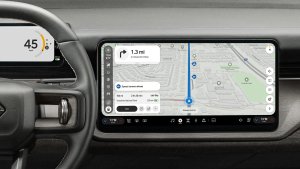
Replacing the countless physical buttons that plague legacy automotive systems, but not going all the way to 100% touchscreens, Rivian has built two large, tactile scroll wheels into its steering wheel. These new halo wheels have haptic controls with dynamic feedback, letting you navigate the R2’s interface with physical buttons - no need to take your eyes off the road to tap a screen or find a particular cabin button. You can check out MKBHD’s review of the R2’s halo wheels below:

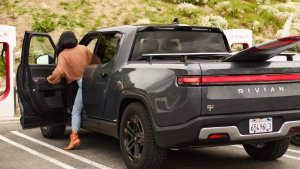
The rear hatch glass can be electronically lowered completely into the tailgate, allowing for a relatively open-air experience in the cabin. While the rear-quarter windows no longer pop out like the initial prototypes, the access to fresh air with the rear glass down is still fantastic

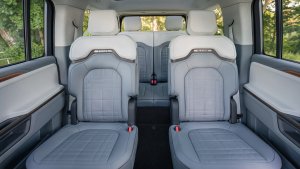
One of the features from the early prototypes that did make it is the fold-flat front and rear seats. Because the R2 is a much smaller vehicle, there isn’t as much room to sleep inside when you’re out adventuring. Because both rows of seats fold flat, there’s still plenty of space to lay out an air mattress and sleep inside.

Rivian Wave

Rivian has also brought back a lot of interior storage space. The glovebox is back, split into two separate, independent compartments. The door card speakers have also been moved into the footwells, freeing up space to store large water bottles or personal items within easy reach.

Pricing & Production Timelines

The most crucial number attached to the R2 isn’t its horsepower or 0-60 time; it is the price tag. Rivian is still officially targeting a starting price of $45,000 for the base single-motor variant.

According to the latest Q4 Earnings Call, production is slated to kick off in Q2 2026 at Rivian’s factory in Normal, Illinois. While it will take some time to scale the assembly lines, RJ expects to deliver between 20,000 and 25,000 R2s before the end of 2025, with one shift running.

In the future, additional shifts will be added to the R2 line to meet demand as more trims roll out. Early reservation holders should expect that the more expensive Dual-Motor Launch Edition trims, likely priced between the high $50,000 and low $60,000 range, will be the first vehicles to roll off the line. 

As with previous Launch Editions, these trims will include all features available at launch, but will not include the upcoming R2 model with LiDAR. If autonomy is one of the things you want out of your R2, it may be best to wait until the LiDAR version launches in early 2027.
RJ Talks About Rivian's R1 Removable Roof Prototype

By Karan Singh
Rivian Wave

In a recent Q&A session with Doug DeMuro, Rivian CEO RJ Scaringe provided a fascinating behind-the-scenes look at one of the R1’s most legendary lost features: the removable roof. For years, early fans of Rivian have wondered what happened to the promise of an open-air Rivian, a feature that would have put the electric adventure vehicles in direct competition with icons like the Jeep Wrangler and Ford Bronco.

Now, we finally have the official story - a short tale of an ambitious design, manufacturing realities, and a glimmer of hope for the future.

The Three-Piece Carbon Fiber Roof

In the interview, RJ confirmed that during the initial development of the R1 platform, Rivian didn’t just consider a removable roof. Instead, they fully engineered and built it. In fact, he also mentioned that a few of the prototypes sporting this special removable roof actually exist within Rivian’s internal fleet.

The design was a sophisticated, three-piece carbon-fiber top that would have replaced the entire standard glass roof, opening up the cabin to the elements. In a brilliant design choice, the three lightweight panels were designed to fit neatly into the R1’s frunk, meaning owners could easily and spontaneously remove their roofs.

That’s a fantastic way to really spice up an adventure, without needing extra hassle or space somewhere else in your vehicle. It truly would’ve leaned into Rivian’s adventure ethos and given us one of the first open-air electric vehicle experiences.

The Reality of Production

So, if the feature was fully tooled and prototypes exist… why can’t you buy one today? The answer, as is often the case in the auto industry, comes down to the immense difficulty of mass production.

RJ explained that they ultimately made the tough decision to cancel the feature for customers due to the added complexity it brought to production and significant challenges with the supply chain. Rivian has already struggled with the R1’s complex supply chain, and simplifying a complex item like this into a single glass roof option likely helped to cut down on production challenges considerably.

For a startup designing and scaling its first vehicle, ensuring a perfect seal and managing logistics for a complex, multi-piece roof system proved to be too much of a hurdle for the initial launch or even for the R1 Gen 2 refresh.

A Glimmer of Hope

While the removable roof for the R1 is officially off the table for now, it may not be gone forever. Acknowledging that the feature has immense appeal, RJ stated that he wouldn’t say never to the idea of bringing it back in the future.

That’s a glimmer of hope for fans of an open-air R1, that as Rivian’s manufacturing processes mature and their production lines finally settle, we may get a real open-air EV experience.

In the meantime, Rivian is building a more pragmatic means for an open-air experience. RJ confirmed that the R2 features a rear glass window that drops down into the tailgate. This combination is designed to bring fresh air right into the vehicle and pull it through the entire cabin, offering a different - but still fantastic way to connect with the outdoors on your adventure.

The inside story of the R1’s removable roof is a classic example of ambitious design meeting the harsh challenges of manufacturing and engineering. While it ultimately ended up on the cutting room floor, it now seems like it could come back in the future. Maybe one day we’ll see the R1 with the option of a removable roof.

You can watch the entire Q&A session below.

Rivian Large+ (Plus) Battery Pack Unlock Coming Soon

By Karan Singh
Rivian Wave

Rivian transitioned to their second-generation vehicles in 2025. One of the goals with their second-gen vehicles was to reduce vehicle costs, so one of the changes was to reduce battery options for these new models.

Rivian slimmed down its battery pack choices by reducing them from four options to three. Instead of offering Standard, Standard+, Large, and Max battery sizes, they now only offer Standard, Large, and Max batteries packs.

However, to reduce complexity further, initial production runs only had two battery sizes — Standard and Max. For customers who ordered a Rivian with a large battery pack, Rivian actually included a Max battery pack software limited to the range of a Large battery. These vehicles were coined as Large+ (Plus) batteries by the community, and Rivian soon adopted the name.

Advantages of a Large+ Battery

For customers who have a software-locked Max battery, there are several perks. Normally, with a lithium nickel manganese cobalt (NMC) battery, you’d want to avoid charging the vehicle to 100% on a daily basis to prevent premature aging. However, with a software-locked Max battery, customers can actually charge to 100% since the vehicle will stop charging once it hits 100% of the “large” battery.

A Max battery pack can store 140 kWh while a Large is 108.5 kWh, so charging to 100% on a Large+ battery is equivalent to charging to just 78% on a Max battery pack. This lets customers continuously take advantage of their vehicle’s full range without any ill effects on battery degradation — a really nice perk.

However, there’s more. According to Wassym Bensaid, Rivian’s Chief Software Officer, Rivian will soon offer customers the ability to unlock the full benefit of the Max battery pack, essentially purchasing the Max battery after the fact.

This is a really nice option, as some customers may discover they could use the extra range, especially as their battery degrades slowly over the years. It’s not a must-have, but having the option is a great addition.

How to Tell If You Have a Large+ Battery

If you’re not sure if your vehicle has a Large+ battery, you can tell by going to your vehicle settings. Your vehicle should have about 300 miles of range. If it has about 250 miles or 400 miles fully charged, then you have a Standard or Max battery pack.

To check if you have a Large or Large+ battery pack, you’ll need to be in your vehicle and navigate to Settings (gear icon), then tap on the About menu item on the left. You’ll see a rendered model of your vehicle and directly underneath, you’ll see your model, which includes the battery pack size. You should see either Large or Large Plus in the model description.

What You Get By Unlocking

We previously dived deep into Rivian’s battery options for both its Gen 1 and Gen 2 R1 series vehicles, but in short, you can expect your Rivian’s range to increase to the same level as a vehicle with a Max battery pack when unlocking the full capacity of the Max battery.

This will take your Rivian R1S or R1T from about 330 miles of range (531 km) to about 420 miles (676 km), depending on the model.

Range Increase

Model

Large/Large+

Max (Dual Motor)

R1T

330 mi / 531 km

420 mi / 676 km

R1S

330 mi / 531 km

410 mi / 660 km

R1S

Large/Large+

Max (Dual Motor)

330 mi / 531 km

410 mi / 660 km

Price to Unlock Max Battery

While Rivian hasn’t announced the price to unlock the Large+ battery’s full potential, expect it to cost about $6,000. This is the same price as purchasing the Max battery pack at the time of configuring your vehicle, so don’t expect a discount, at least initially.

It’s possible as these vehicles get older, Rivian realizes that people may not want to buy a $6,000 add-on for a 5 or 10-year-old vehicle, and at that point, they may consider lowering the price.

Performance Upgrade: Rivian recently announced the ability to purchase the Performance option for dual motor vehicles as well, so owners of Large+ battery packs can double dip and get the Max battery pack and unlock the Performance version of their vehicle as well. Rivian priced the Performance software upgrade at $5,000, which is also the same price as getting it from the factory.

How to Unlock Large+

While the ability to unlock your Large+ battery pack isn’t available yet, expect the upgrade option to be available in the Rivian app and in the vehicle — similar to the Performance upgrade.

Release Date

Wassym didn’t say when the software battery unlock would arrive, but it seems that it will be coming as part of a future OTA update, which will bring the purchase option to your Rivian. Just like with the Dual Performance upgrade, you’ll be able to use Rivian Reward credits towards the unlock as well.

Latest Rivian Update