Rivian’s engineering teams have been hard at work on the R2 for quite some time now. One of their primary goals - to reduce per-unit cost of the drive units.
The new Maximus drive unit uses some interesting techniques to help reduce costs and build on lessons learned from the R1 Series Enduro units.
Improvements All Around
The first improvement is in the stator windings. The stators are a critical component of an electric motor, and reducing the number of welds inside the stator is a key to reducing overall cost. The new Maximus drive unit uses a new continuous winding technology, reducing the total welds per stator from 264 on the Enduro to just 24 on the Maximus.
Rivian has also worked to consolidate and reduce the number of physical parts in the R2. Their second development on this front is integrating the rotor shaft and the gear into a single forged component, which is CNC milled. Of course, that’s not all - they also reduced the number of bearings.
Overall, that’s a fantastic set of improvements to help reduce the cost - and weight - of the upcoming R2’s new Maximus drive unit. The R2’s launch will be Rivian’s Model 3 moment - it will be the mass-adoptable mid-size vehicle that many are interested in. As such, driving down costs per unit is key.
The new single-piece rotor shaft and gear.
Rivian Wave
Coming to R1S & R1T?
The next question is: Will these improvements make their way to the R1S and R1T? It seems likely in the future—but not immediately. These improvements are set to greatly reduce Rivian’s per-vehicle costs, which will also help increase profit margins.
While Rivian did—for the first time—have a profitable quarter in Q4 2024, they’re still teetering on the edge of profitability. Sharing as many parts between the R2 and R1 vehicles makes a lot of sense, and you can bet Rivian will take advantage of that if they can.
Rivian’s focus is on the R2 launch, so it may take some time before they shift attention back to the R1 series and implement these cost-saving improvements. When Rivian finally introduces Gen 2.5 of the R1S and R1T, we may see other improvements taken from the R2 besides this improved drive unit.
Subscribe
Subscribe to our newsletter to stay up to date on the latest Rivian news, upcoming features and software updates.
Rivian is moving quickly to address a security oversight that has left some owners feeling vulnerable. After a high-profile report of an accidental frunk opening, the company’s software team has confirmed that new safeguards are officially in development to prevent "butt-dialing" your storage space.
The issue gained traction after X user @dictionaryhill shared a stressful experience at the gym. Recently, when coming out of the gym one day, they noticed that their R1T’s frunk was open with their backpack and other belongings simply there for anyone to potentially grab. The situation was particularly risky because the frunk contained an iPad, a wallet, and $1,000 in cash from a recent Facebook Marketplace sale. Despite having proximity unlocking turned off, the front trunk had sat wide open in a public parking lot for several minutes.
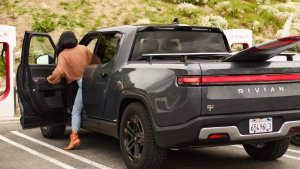
When I came out the gym today, I found my Truck with the frunk open and my backup untouched. It had a Rivian Carabiner key attached to it (I have proximity unlocking off) My iPad, Wallet and countless other crap.
After reaching out to the owner, Rivian’s team was able to verify that the command came from a phone widget. According to Rivian, @dictionaryhill’s iPhone sent out a frunk opening command at 11:50 a.m., which the owner said originated from an accidental screen tap. They walked out of their gym and discovered the truck open just seven minutes later.
Accidental taps on smartphone widgets are a common frustration for EV owners. Because these buttons are designed for quick access, they often lack the "Are you sure?" confirmation required for such a significant physical action. Rivian’s Chief Software Officer, Wassym Bensaid, joined the conversation to acknowledge the flaw. "We can still do a better job to protect from some of the accidental taps with the iOS widgets. Working on it," Bensaid stated.
Learning from the Competition
Rivian isn't the first company to deal with this. Tesla, for example, has a built-in safeguard that asks for confirmation on the screen if you try to open the frunk while your phone key is not actively connected to the vehicle. This ensures that if you accidentally tap the button from a mile away, the car won't just pop open. However, if you are standing right next to the car, it assumes the intent is real and opens immediately.
Rivian Wave
Rivian is currently on a roll with highly requested software updates, recently confirming a new battery health menu is also on the way. Adding a confirmation step or a "long-press" requirement for the frunk widget would be a simple but effective fix to keep gear safe, while a proximity check before the command is executed would be a more complex but convenient solution. This is especially important as the company prepares to launch the highly anticipated R2, which features a spacious front trunk that will likely be a primary storage spot for many new owners.
While @dictionaryhill was lucky this time, the incident highlights the growing pains of software-defined vehicles. Rivian’s willingness to engage directly with owners and push out fixes over-the-air remains one of its biggest strengths. We expect to see these new "anti-accidental" options arrive in an upcoming update, perhaps in time for the first R2 deliveries later this spring.
Rivian recently published a patent detailing an innovative rear lighting system for its upcoming vehicles. Titled "Lighting Features for a Lift Gate of a Vehicle," the patent was officially published on March 31, 2026. The document reveals exactly how Rivian plans to keep its SUVs highly visible and legally compliant even when driving with the rear hatch wide open.
Always-Visible Lift Gate
The most practical feature outlined in the patent involves secondary light sources hidden within the lift gate assembly. When a driver hauls an oversized load with a standard lift gate in the open position, the traditional taillights mounted on the hatch are often pointed directly at the sky. Rivian solves this by embedding an additional light source along the bottom edge of the lift gate's interior.
When the vehicle's sensors detect that the lift gate is open, the primary exterior light is deactivated. The system then automatically activates the secondary edge-mounted light source. This ensures a light beam is directed straight back toward trailing vehicles rather than up into the air, functioning perfectly as an active taillight and brake light while the hatch is raised.
Built-In Safety Without the Accessory Cost
This patented solution directly addresses a visibility issue that current Rivian owners already face. For example, when R1T owners haul oversized items with the tailgate down, or when they mount large gear like a rooftop tent that obscures the center high-mounted stop lamp, rear visibility drops significantly.
To combat this, Rivian sells a standalone Auxiliary Brake Light accessory for $200. This newly patented lift gate lighting system completely eliminates the need for that expensive add-on. By building the secondary lights directly into the lift gate assembly, Rivian is ensuring that its future vehicles maintain peak visibility straight from the factory.
This inherently improves safety for all road users by guaranteeing that trailing drivers always have a clear, immediate view of the vehicle's braking intentions, regardless of how much gear is packed into the back.
Rivian Wave
Nested Light Signatures
The patent also provides a detailed look at the complex geometry of the rear light bar. The primary taillight is described as having a first end and a second end. Rather than placing turn signals and brake lights in completely separate housings, Rivian surrounds the ends of the main light bar with C-shaped and U-shaped secondary lights.
For example, a dedicated turn signal light completely wraps around the outer edge of the main taillight in a distinctive C-shape. This nested design allows the vehicle to simultaneously illuminate multiple distinct indicators from a highly compact lighting housing.
Aerodynamic Spoiler Integration
Beyond the lift gate itself, the patent details how Rivian is integrating lighting into the upper rear spoiler to maximize aerodynamics. The document outlines a center high-mounted stop lamp that protrudes directly from the spoiler.
However, the spoiler is not mounted flush against the vehicle body. Instead, it defines dedicated spaces between the spoiler structure and the rear of the vehicle. These specific voids allow air to pass cleanly under and through the spoiler assembly while the vehicle is in motion, greatly enhancing the overall aerodynamic efficiency of the SUV.