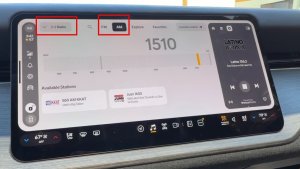
With more and more information beginning to slowly trickle out about what the R2 will be packing, we’ve finally got the details on the R2’s next-gen infotainment chipset. Just like the Gen 2 R1 series vehicles, the R2’s chipset will also be responsible for all the AI capabilities - which includes addressing Rivian’s autonomy ambitions.
Infotainment on Gen 1 and Gen 2
Rivian’s Gen 1 processor had three ECUs on board and was relatively capable—but hamstrung in its own ways. It couldn’t process high-resolution imagery and was only as capable as the Mobileye EyeQ4 that was on board. Many users also noted the distinct lag that occasionally happened in the infotainment, especially when rapidly scrolling the map with the satellite view mode.
Gen 2, on the other hand, consolidates those three original ECUs down to one and packs 3.3x the neural processing power on board—alongside 4K image processing. That, along with an effective, smooth, and precise infotainment system, made Gen 2’s XMM2 infotainment chipset a highlight. Now, the R2’s infotainment unit is going to take it to another level.
More Power, More Compact
The R2 and the R3 will feature the XMM3 chipset, which consolidates chips—including memory and power chips—at a 4:1 ratio. This unit will also have 2.4x the compute power of the current Gen 2 XMM2 unit.
This sparks a pretty interesting question—what about Autonomy? Rivian has said they’ve gained a renewed interest in addressing vehicle autonomy. Rivian plans to launch “eyes-off” highway autonomy in 2026 and hands-free highway assist will launch on the Gen 2 in just a couple of weeks with software update 2025.06.
That begs the question, will Rivian require the XMM3 chipset for future autonomy goals such as eyes-off or future Platform+ features?
What About R1S & R1T?
Just like the improvements to the drive units that are coming to the R2, these infotainment improvements will likely eventually make their way over to R1S and R1T as well. Given that Rivian just recently finished retooling their production lines for R1 Gen 2 vehicles, we’d expect them to arrive after the launch of the R2.
With that said, Gen 2.5 or Gen 3, whichever Rivian decides to call it, it’s likely still a couple of years away, but expect it to take advantage of a lot of newer R2 components.