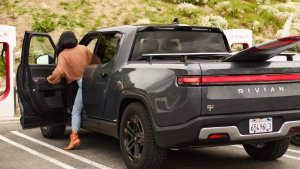
Rivian has built a reputation on outfitting its vehicles with unique capabilities designed specifically for off-road environments. While its engineers previously experimented with a Tank Turn feature that allowed the R1T to spin completely in place, that feature was ultimately scrapped due to the severe environmental damage it caused to trails.
However, a newly published patent titled "Systems and Methods for Providing a Vehicle with a Torque Vectored K-Turn Mode" (US12576849 B2) reveals that Rivian’s engineers have developed a new, more refined solution for navigating impossibly tight corners.
The Evolution of the Turn
The core concept behind this new patent is to use Rivian’s independent motor architecture to control how the vehicle rotates about its own chassis. When a standard vehicle turns, the turning radius is limited by how far the front wheels can physically pivot. The newly patented Kick-Turn Mode bypasses this physical limitation by applying opposing forces to the front and rear axles.
Kick Turn helps your Quad pivot like it’s got dance moves. That's the magic of four motors with fully independent torque vectoring.
— Rivian (@Rivian) July 10, 2025
*Coming to MY26 Quad vehicles in September via software update. pic.twitter.com/MjaHIzrqgt
How the Kick-Turn Actually Works
According to the patent, the vehicle’s control circuitry constantly monitors the steering wheel input. When a driver turns the steering wheel past a specified threshold (for example, past 70 percent of its maximum rotation or after completing 2.5 full revolutions), the system automatically engages the Kick-Turn Mode.
Once engaged, the vehicle fundamentally changes how it distributes power. When the driver presses the accelerator, the system provides forward torque to the turned front wheels while simultaneously applying backward torque to the rear wheels.
This opposing torque distribution creates a unique physical dynamic. The forward torque causes the turned front wheels to intentionally slip laterally across the ground, pulling the front of the vehicle through the turn.
Meanwhile, the backward torque applied to the rear wheels keeps them in substantial static contact with the ground. By anchoring the rear wheels and sliding the front wheels, the vehicle effectively pivots around a point located directly underneath the rear chassis, resulting in a dramatically tighter turning radius than a conventional steering maneuver could ever achieve.
The Front Dig Mode Alternative
The patent also details a secondary, less aggressive turning feature called "Front Dig Mode". This mode is engaged when the steering wheel is turned past a "lower turn threshold" (for example, 1.5 revolutions) but hasn't yet reached the full Kick-Turn threshold.

In Front Dig Mode, the system provides forward torque to the turned front wheels and forward torque to the outer rear wheel. However, the system actively applies resistance, either by applying the physical brake or inducing backward torque, to the inner rear wheel. This essentially drags the inner rear wheel, acting as a pivot anchor that tightens the turn radius, though not quite to the extreme degree of the full Kick-Turn Mode.
Intelligent Safeguards
Rivian's patent notes that these torque-vectored turns require precise control. The vehicle's control circuitry constantly monitors wheel slip, vehicle rotation rate, and throttle input. If the system detects that the vehicle is rotating too fast, or if a rear wheel begins to slip during a Kick-Turn, the computer will instantly adjust the torque output or apply the brakes to correct the maneuver and ensure the vehicle remains stable.
The system can even detect if the vehicle is on an incline or a banked surface and automatically adjust the torque distribution to compensate for gravity. Rivian’s Kick-Turn feature is currently available on 2nd-Generation Quad-Motor R1S and R1T variants. It is not available for Gen 1 Quad-Motor vehicles due to changes in the ECU and drivetrain architectures.