Rivian’s R3 Innovative Rear Tailgate Lighting Revealed in New Patent

By Karan Singh
Rivian Wave

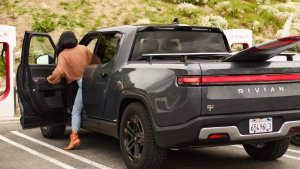
Rivian recently published a patent detailing an innovative rear lighting system for its upcoming vehicles. Titled "Lighting Features for a Lift Gate of a Vehicle," the patent was officially published on March 31, 2026. The document reveals exactly how Rivian plans to keep its SUVs highly visible and legally compliant even when driving with the rear hatch wide open.

Always-Visible Lift Gate

The most practical feature outlined in the patent involves secondary light sources hidden within the lift gate assembly. When a driver hauls an oversized load with a standard lift gate in the open position, the traditional taillights mounted on the hatch are often pointed directly at the sky. Rivian solves this by embedding an additional light source along the bottom edge of the lift gate's interior.

When the vehicle's sensors detect that the lift gate is open, the primary exterior light is deactivated. The system then automatically activates the secondary edge-mounted light source. This ensures a light beam is directed straight back toward trailing vehicles rather than up into the air, functioning perfectly as an active taillight and brake light while the hatch is raised.

Built-In Safety Without the Accessory Cost

This patented solution directly addresses a visibility issue that current Rivian owners already face. For example, when R1T owners haul oversized items with the tailgate down, or when they mount large gear like a rooftop tent that obscures the center high-mounted stop lamp, rear visibility drops significantly.

To combat this, Rivian sells a standalone Auxiliary Brake Light accessory for $200. This newly patented lift gate lighting system completely eliminates the need for that expensive add-on. By building the secondary lights directly into the lift gate assembly, Rivian is ensuring that its future vehicles maintain peak visibility straight from the factory. 

This inherently improves safety for all road users by guaranteeing that trailing drivers always have a clear, immediate view of the vehicle's braking intentions, regardless of how much gear is packed into the back.

Rivian Wave

Nested Light Signatures

The patent also provides a detailed look at the complex geometry of the rear light bar. The primary taillight is described as having a first end and a second end. Rather than placing turn signals and brake lights in completely separate housings, Rivian surrounds the ends of the main light bar with C-shaped and U-shaped secondary lights.

For example, a dedicated turn signal light completely wraps around the outer edge of the main taillight in a distinctive C-shape. This nested design allows the vehicle to simultaneously illuminate multiple distinct indicators from a highly compact lighting housing.

Aerodynamic Spoiler Integration

Beyond the lift gate itself, the patent details how Rivian is integrating lighting into the upper rear spoiler to maximize aerodynamics. The document outlines a center high-mounted stop lamp that protrudes directly from the spoiler.

However, the spoiler is not mounted flush against the vehicle body. Instead, it defines dedicated spaces between the spoiler structure and the rear of the vehicle. These specific voids allow air to pass cleanly under and through the spoiler assembly while the vehicle is in motion, greatly enhancing the overall aerodynamic efficiency of the SUV.

Rivian to Add New Battery Health Menu in Future Update

By Nehal Malik
Rivian Wave

For years, Rivian owners have had to play detective to figure out exactly how much life is left in their battery packs. Whether it’s comparing current maximum range to original "as-new" figures or diving into third-party API tools to see the estimated usable kWh, getting a straight answer has been a bit of a chore. However, that is finally about to change.

According to EPA certification documentation for the R2 that surfaced online earlier this week, Rivian is officially working on a dedicated battery health menu. This new feature will be delivered to vehicles via a future over-the-air (OTA) software update, bringing a level of transparency to the "About" screen that owners have been requesting for a long time.

What’s Coming to the Battery Menu

The leaked documentation reveals that the new menu will provide several key data points that were previously hidden from the user interface. Owners will soon be able to see:

  • Battery state of health: A clear percentage representing the pack’s current capacity relative to when it was new.

  • Distance since last updated: A timestamp of sorts showing when the health metric was last calculated.

  • Max potential charge rate: The peak speed at which your specific pack can currently accept power.

  • Current charge rate: Real-time data on how fast the vehicle is charging at that moment.

Currently, owners who want this level of detail often have to navigate into Rivian’s hidden RiDE (service) mode and do some quick math or rely on third-party telemetry services. Being able to pull up an exact number for battery state of health without doing some mental gymnastics or needing a service visit is a massive win for long-term ownership confidence.

Timing and the R2 Connection

While the R2 EPA certificate confirmed the feature's existence, there is no official word yet on exactly when it will roll out to the fleet. The Rivian lineup is currently overdue for a major software update, and we expect one to start rolling out publicly in the coming weeks.

It is possible that this menu will debut alongside the first R2 Performance deliveries later this spring. Since the R2 is built on a new architecture with a native heat pump and updated battery specs, launching a more detailed health menu at the same time makes a lot of sense for the brand's next-gen push.

Providing this level of transparency is a smart move by Rivian. As these vehicles age and enter the used market, having a "certified" battery health percentage visible in the settings will be a crucial tool for both current owners and future buyers. It’s exactly the kind of "pro-consumer" software move that separates modern EV makers from traditional legacy brands.

Inside the Engineering Behind Rivian’s Kick-Turn

By Karan Singh
Rivian Wave

Rivian has built a reputation on outfitting its vehicles with unique capabilities designed specifically for off-road environments. While its engineers previously experimented with a Tank Turn feature that allowed the R1T to spin completely in place, that feature was ultimately scrapped due to the severe environmental damage it caused to trails.

However, a newly published patent titled "Systems and Methods for Providing a Vehicle with a Torque Vectored K-Turn Mode" (US12576849 B2) reveals that Rivian’s engineers have developed a new, more refined solution for navigating impossibly tight corners.

The Evolution of the Turn

The core concept behind this new patent is to use Rivian’s independent motor architecture to control how the vehicle rotates about its own chassis. When a standard vehicle turns, the turning radius is limited by how far the front wheels can physically pivot. The newly patented Kick-Turn Mode bypasses this physical limitation by applying opposing forces to the front and rear axles.

How the Kick-Turn Actually Works

According to the patent, the vehicle’s control circuitry constantly monitors the steering wheel input. When a driver turns the steering wheel past a specified threshold (for example, past 70 percent of its maximum rotation or after completing 2.5 full revolutions), the system automatically engages the Kick-Turn Mode.

Once engaged, the vehicle fundamentally changes how it distributes power. When the driver presses the accelerator, the system provides forward torque to the turned front wheels while simultaneously applying backward torque to the rear wheels.

This opposing torque distribution creates a unique physical dynamic. The forward torque causes the turned front wheels to intentionally slip laterally across the ground, pulling the front of the vehicle through the turn. 

Meanwhile, the backward torque applied to the rear wheels keeps them in substantial static contact with the ground. By anchoring the rear wheels and sliding the front wheels, the vehicle effectively pivots around a point located directly underneath the rear chassis, resulting in a dramatically tighter turning radius than a conventional steering maneuver could ever achieve.

The Front Dig Mode Alternative

The patent also details a secondary, less aggressive turning feature called "Front Dig Mode". This mode is engaged when the steering wheel is turned past a "lower turn threshold" (for example, 1.5 revolutions) but hasn't yet reached the full Kick-Turn threshold.

Rivian Wave

In Front Dig Mode, the system provides forward torque to the turned front wheels and forward torque to the outer rear wheel. However, the system actively applies resistance, either by applying the physical brake or inducing backward torque, to the inner rear wheel. This essentially drags the inner rear wheel, acting as a pivot anchor that tightens the turn radius, though not quite to the extreme degree of the full Kick-Turn Mode.

Intelligent Safeguards

Rivian's patent notes that these torque-vectored turns require precise control. The vehicle's control circuitry constantly monitors wheel slip, vehicle rotation rate, and throttle input. If the system detects that the vehicle is rotating too fast, or if a rear wheel begins to slip during a Kick-Turn, the computer will instantly adjust the torque output or apply the brakes to correct the maneuver and ensure the vehicle remains stable. 

The system can even detect if the vehicle is on an incline or a banked surface and automatically adjust the torque distribution to compensate for gravity. Rivian’s Kick-Turn feature is currently available on 2nd-Generation Quad-Motor R1S and R1T variants. It is not available for Gen 1 Quad-Motor vehicles due to changes in the ECU and drivetrain architectures.

Latest Rivian Update