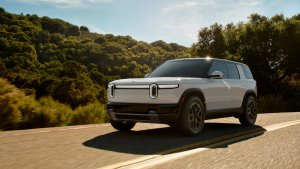
Rivian’s SXSW 2026 showcase is in full swing, and while the company has already shared plenty of smaller details about its upcoming R2 SUV, a new teaser from the stage suggests there might be even more utility on the horizon. During a "Driven by Rivian" event in Austin, executives hinted that the R2’s rear design could eventually evolve to include a feature beloved by truck owners: a functional tailgate.
A video clip from the event, shared by EV watcher David Moss, shows a Rivian executive being asked directly if a tailgate was ever in the cards for the R2. The response was telling: "Yeah, we did. For this vehicle specifically, we decided on having the glass drop. But that's not to say we haven't explored the idea — I'll just leave it at that." The cheeky delivery of that line has immediately sparked speculation that a future variant or accessory could bring a split-gate or fold-down tailgate to the R2 platform.
As it stands, the R2 is launching with a signature "Drop Glass" feature on its Performance and Premium trims. This allows the rear window to roll completely into the liftgate, providing a "safari-style" open-air experience and making it incredibly easy to haul long gear like surfboards. However, this feature is not included on the more affordable R2 Standard trims, which are expected to start at $45,000.
Rivian Wave
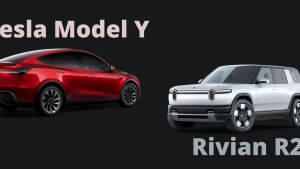
Adding a tailgate would take the R2’s utility to another level, potentially allowing it to function more like a mini-truck for camping and tailgating. Given that the R2 is critical to Rivian’s path to profitability, differentiating it from the Tesla Model Y with superior "adventure" features is a smart move. Rivian is already offering public rides in production R2 units at SXSW 2026, but the executive's comments suggest the design remains iterative.
R2 Lineup Refresher
Rivian's current plan involves three main versions of the SUV. The Performance trim will be the first to arrive in Spring 2026, followed by the Premium and Standard models.
Feature
R2 Performance
R2 Premium
R2 Standard (LR)
Starting Price
$57,990
$53,990
$48,490
Est. Delivery
Spring 2026
Late 2026
Early 2027
Drivetrain
Dual-Motor AWD
Dual-Motor AWD
Single-Motor RWD
Range
330 mi (EPA)
330 mi (EPA)
345 mi (Rivian)
Horsepower
656 hp
450 hp
350 hp
0–60 mph
3.6 sec
4.6 sec
5.9 sec
Drop Glass
Included
Included
Not Available
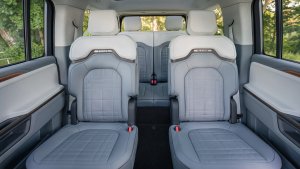
Every R2 model features a 9.6-inch ground clearance and an 87.9 kWh battery. Rivian hasn’t revealed much about its most affordable R2 trim, which is supposed to only cost $45,000, beyond a late 2027 launch date. While the Performance model gets the most "fun" modes like Rally and Soft Sand, a future "Utility" or "Adventure" package featuring a tailgate would likely appeal to the crowd that currently looks at the R1T for its gear-hauling capabilities.
As Rivian prepares for its spring 2026 R2 launch, the hint of a tailgate shows that they are listening to customer feedback. Whether it arrives as a mid-cycle refresh or a specialized trim, the R2 is shaping up to be one of the most versatile electric vehicles on the road.
Subscribe
Subscribe to our newsletter to stay up to date on the latest Rivian news, upcoming features and software updates.
Rivian has officially unveiled the full production specs for its highly anticipated R2. While the broad strokes, like the $45,000 starting price and 300+ miles of range, are the dominating headline items, there’s a lot to look at as you go down the spec sheet and compare the variants.
If you are making a reservation for the midsize electric SUV, the trim you select will affect the available features and options. From missing hardware on the base model to optional upgrades, here are all the "little things" you need to know about the R2 lineup.
MagSafe Charging for All
Rivian Wave
One of the most universal complaints about the flagship R1 vehicles has been the notoriously finicky wireless charging pad. Brake too hard, and your phone would go flying off the charging pad if it bothered to charge in the first place.
Rivian has clearly listened to the feedback. The R2 features a completely redesigned center console with integrated magnetic wireless charging. This MagSafe-compatible design keeps your phone locked in place and charging, even when you are throwing the R2 around on an off-road trail.
No Drop Glass on Standard Model
Rivian Wave
One of the standout features of the R2's design is its rear window, which drops completely down into the tailgate to provide an open-air, safari-like driving experience (and allows you to haul long items like surfboards easily).
However, this feature is reserved for the Premium and Performance trims. If you buy the base Standard trim, the rear glass is fixed. This helps reduce costs and opens the door to the $45,000 price point Rivian is looking to meet later next year.
No Tow Hooks on Standard
Rivian Wave
Rivian built its brand on rugged, go-anywhere adventure DNA. Tow hooks are practically a staple of the Rivian aesthetic.
However, to keep costs down on the entry-level configurations, the R2 Standard trim drops the prominent front tow hooks entirely. You will need to step up to the Premium or Performance tiers to get them equipped from the factory.
Between this and the drop glass, Rivian has squarely placed the Standard as a regular vehicle that could do some light adventuring, while the Premium and Performance are your true electric adventure vehicles.
No Adaptive Headlights on Standard
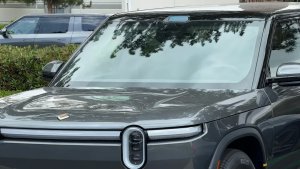
All R2 models come equipped with Rivian's signature stadium-shaped headlights utilizing Matrix LED technology. But there is a software and hardware catch: the Standard trim lacks the Adaptive High Beam functionality found on the upper trims.
If you want your R2 to automatically map and dim specific LED zones around oncoming traffic at night, you have to upgrade to the Premium or Performance models.
Future, Smaller Pack
Rivian is heavily marketing the R2's $45,000 starting price, but that specific vehicle won't arrive until late 2027. When it does, it will be equipped with a smaller battery pack.
The initial Standard Long Range trim (arriving in early 2027 for $48,490) features a larger 87.9 kWh pack capable of 345 miles of range. The delayed $45,000 base model will trade that larger pack for a smaller one, aiming for roughly 275 miles of range to hit its aggressive price target.
Semi-Active Suspension
Because the R2 is built to a much lower price point than the R1, it abandons the complex, expensive air suspension of its bigger sibling. The Standard and Premium trims utilize a traditional, static spring-and-damper suspension setup.
However, the top-tier R2 Performance trim gets a major handling upgrade with an exclusive Semi-Active suspension system, allowing the vehicle to dynamically adjust its damping rates on the fly for better cornering and off-road articulation.
Rivian’s highly anticipated R2 has officially launched, bringing a more compact and affordable vehicle to the brand’s expanding lineup.
While the R2 introduces a host of clever interior storage and seating innovations, one of the most exciting new accessories to debut alongside the vehicle is the "Field Outlet.” This is a plug-and-play device that transforms the R2 into a massive off-grid power bank.
Powering Your Devices
Resigned specifically for the R2's native NACS (North American Charging Standard) port, the Field Outlet accessory provides users with two standard 120V AC outlets. There isn’t support for 240V accessories, and Rivian isn’t specifying how many amps the adapter can deliver. Expect it to be similar to Tesla’s V2L version, which can deliver up to 20 amps at 110V, or about 2,200 watts.
This essentially turns the R2 into a mobile power station, eliminating the need to haul heavy, separate battery packs or gas generators into the wilderness. Whether you need to run lights, power a coffee maker, or charge up laptops and tools, the Field Outlet is tailored for car camping or tackling off-grid outdoor tasks.
Rivian Wave
Supported Vehicles
While current Rivian owners might be eager to get their hands on this accessory, the Field Outlet is exclusively designed for the next-generation R2 architecture.
Unfortunately, it is not backwards compatible with the flagship R1T pickup or R1S SUV, even those with a NACS port. The technical limitation lies within the charging hardware itself. Older R1 vehicles (whether Gen 1 or Gen 2) do not feature the necessary bi-directional AC power conversion hardware integrated into the charge port. Rivian specifically engineered the R2's charging system to support this power export capability from day one.
By integrating bi-directional capability directly into the NACS port, Rivian leans heavily into its signature adventure DNA, ensuring that the smaller, $45,000 R2 doesn't sacrifice the extreme outdoor utility that the brand is known for.