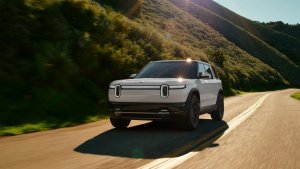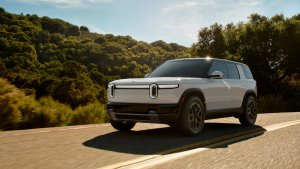
When Rivian officially unveiled the R2 this week, everyone immediately began comparing the new midsize SUV to its older, larger sibling, the R1S. But during the reveal event, one of Rivian’s engineers dropped a fascinating piece of trivia that completely recontextualizes the relationship between the two vehicles: "R1S was actually born from R2. The team has been working on R2 since 2017."
While the R1S beat the R2 to the market alongside the R1T to establish Rivian as a premium adventure brand, the R2 is the vehicle the company was originally founded to build. Now that the production specs are finally public, it is clear that these two SUVs target vastly different demographics.
If you are torn between putting down a $100 reservation for the R2 or taking immediate delivery of an R1S, here is a definitive section-by-section comparison of Rivian’s expanding SUV lineup.
Price & Variants
The most obvious difference between the two vehicles is the price tag. The R1S is a premium, luxury-tier vehicle. Currently, the flagship SUV starts at roughly $74,900 for the base Dual-Motor configuration and can easily push past $90,000 if you opt for the Quad-Motor or Max battery pack options.
Variant | Rivian R1S | Rivian R2 |
|---|---|---|
Base / Standard | Dual-Motor Standard: ~$74,900 | Single-Motor Standard: $45,000 |
Long Range | Dual-Motor Large/Max: ~$81,900+ | Single-Motor Standard LR: $48,490 |
Premium | Performance Dual-Motor: ~$89,900+ | Dual-Motor Premium: $53,990 |
High Performance | Tri-Motor Max: ~$105,900 | Dual-Motor Performance: $57,990 |
Flagship | Quad-Motor Max: ~$119,900 | A tri-motor option for the R2 may become available in the future. |
The R2, on the other hand, is built for the mass market. It arrives with three primary variants: a Single-Motor Standard trim starting at $45,000, a Dual-Motor Premium trim at $53,990, and a high-performance Dual-Motor variant capping out at $57,990.
However, it is worth noting that the $45,000 base R2 will not arrive until late 2027, while the R1S is available right now.
Size & Storage


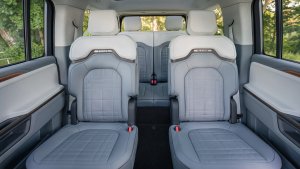
The R1S is a massive, three-row family hauler. Measuring 200.8 inches long, it comfortably seats seven passengers and offers an enormous amount of cargo space, making it a direct competitor to the larger EVs like the EV9 or the Escalade IQ.
Dimension / Feature | Rivian R1S | Rivian R2 |
|---|---|---|
Length | 200.8 inches | 185.9 inches |
Width (Mirrors Folded) | 82.0 inches | 78.1 inches |
Seating Capacity | 7 Passengers (3 Rows) | 5 Passengers (2 Rows) |
Rear Cargo (Seats Up) | 17.6 cu ft | ~25.0 cu ft |
Rear Cargo (Seats Down) | 88.2 cu ft | ~65.0 cu ft |
Frunk Storage | 11.1 cu ft | ~6.0 cu ft |
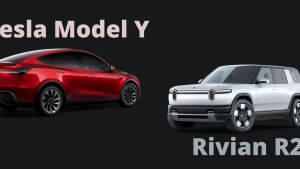
The R2 shrinks down significantly to compete with the Tesla Model Y. At 185.9 inches long, the R2 seats only five passengers across two rows. However, Rivian engineered some clever storage tricks to maximize the smaller footprint.
Despite the R1S being larger, the R2 features dual glove boxes and a hidden dash drawer, things the R1S notoriously lacks for internal storage and ease of access.
Battery & Charging
The R1S offers massive battery packs to offset its weight and size, with options up to 149 kWh for around 400 miles of range. The R2 was engineered for the modern EV landscape. It features a much smaller 87.9 kWh battery pack, but because the vehicle is nearly 2,000 pounds lighter than the R1S, it can still achieve up to 345 miles of range.
Feature | Rivian R1S | Rivian R2 |
|---|---|---|
Battery Pack Options | Standard, Large, Max (up to 149 kWh) | Standard, Long Range (87.9 kWh) |
Max Range | Up to 410 miles (Dual Max) | Up to 345 miles (Standard LR) |
Max Charging Speed | Up to 220 kW | Up to 220 kW |
Charge Port Type | NACS (Current) / CCS (Older Models) | Native NACS |
Rivian recently transitioned the R1 series to the NACS port, and the R2 follows suit, featuring a native NACS port. That means you can plug into a Supercharger or other NACS charging site without needing an adapter.
R2’s port also features bi-directional AC power, allowing R2 owners to use the new Field Outlet accessory to plug standard 120V devices right into the side of the car, a feature the R1S does not physically support.
Motors & Hardware
When it comes to raw power, the R1S is a monster. The Quad-Motor setup delivers over 830 horsepower and a 0-60 time of roughly 3.0 seconds, making a 7,000-pound SUV move like a supercar.
Specification | Rivian R1S | Rivian R2 |
|---|---|---|
Motor Configurations | Dual, Performance Dual, Tri, Quad | Single (RWD), Dual (AWD) |
Base Horsepower | 533 hp (Dual) | 350 hp (Single) |
Mid Horsepower | 664 hp (Performance Dual) | 450 hp (Premium Dual) |
Max Horsepower | 850 hp (Tri) / 1,025 hp (Quad) | 656 hp (Performance Dual) |
0-60 mph (Fastest Trim) | ~2.5 seconds (Quad) | 3.6 seconds (Performance) |
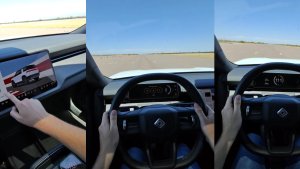
The R2 opts for a more practical approach. It maxes out with a Dual-Motor AWD setup on the Performance trim, delivering 656 horsepower and a 3.6-second 0-60 mph time. While not quite as violently fast as the top-tier R1S, the R2 Performance is still incredibly quick for its price bracket.
Offroading Capability
If you are serious about adventure, the R1S is still the undisputed king. It features an incredibly useful air suspension system that allows the vehicle to raise its ground clearance to a staggering 14.9 inches on the fly.
Feature | Rivian R1S | Rivian R2 |
|---|---|---|
Suspension Type | Height-Adjustable Air Suspension | Static Springs / Semi-Active (Performance) |
Max Ground Clearance | 14.9 inches | 9.6 inches (Fixed) |
Tow Hooks | Standard on all trims | Premium and Performance trims only |
Approach Angle | 35.6 degrees | 25.0 degrees |
Departure Angle | 34.3 degrees | 27.0 degrees |
To hit its lower price point, the R2 completely ditches the air suspension. The Standard and Premium R2 trims rely on traditional static springs, while the Performance trim uses a Semi-Active setup.
Regardless of the trim, the R2 has a fixed ground clearance of 9.6 inches. Furthermore, the base R2 completely lacks the iconic front tow hooks found standard on every R1S. The R2 is perfect for dirt roads and snowy trails, but the R1S is built to conquer Moab.
Autonomy Capability
The R1S features Rivian's standard RAP+, which works wonderfully on mapped interstates but relies on a slightly older sensor suite.
The R2 is taking a massive leap forward in autonomy. It launches with Rivian’s next-generation perception stack, featuring 11 cameras and 5 radars. This new hardware powers Autonomy+, an upcoming software suite designed to allow for hands-free driving on a much wider array of roads, putting it closer in competition to Tesla's FSD hardware.
Beyond the Spec Sheet
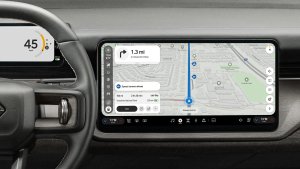
Beyond the spec sheet, the R2 introduces a handful of major quality-of-life updates that standard R1S owners have been begging for. The R2 features a brand-new steering wheel with haptic scroll wheels, finally solving the frustrating interface issues of the R1.
The R2 also introduces dedicated MagSafe wireless charging in the center console, fixing the notoriously slippery R1 charging pad.
Finally, while the R1S features a split-folding tailgate, the R2 introduces a much-loved drop glass feature, where the entire rear window rolls down into the liftgate to allow for an open-air driving experience or to easily transport long items like lumber or surfboards. However, a Rivian executive recently mentioned a tailgate could arrive in the future, potentially even in the Standard model, which doesn’t include the drop glass feature.