Rivian and Volkswagen Provide Additional Details on Joint Venture, Now Totaling $5.8 Billion

By Karan Singh
Rivian Wave

Rivian and Volkswagen released an update to their Joint Venture, which was announced in June of this year. In the original announcement, Volkswagen promised to invest $5 billion in Rivian—$1 billion immediately and another $4 billion over time—for an equally controlled and owned joint venture.

“The partnership with Rivian is the next logical step in strengthening our global competitive and technological position.”

-- Oliver Blume, CEO of Volkswagen

The goals were to help Rivian reduce its cost per vehicle, while also helping Volkswagen with software and zonal control technology. This collaboration presents an incredible opportunity for Rivian, positioning its technology and software as the foundation for future EVs developed through the joint venture. Crucially, Rivian retains its intellectual property rights, opening up a substantial new revenue stream for the company.

JV Update

The JV has been updated with a total deal size of up to $5.8 billion now—which is an addition of another $800 million to the original proposal. Rivian and Volkswagen will send engineers to join the JV, which will be co-headed by Rivian’s Wassym Bensaid and Volkswagen’s Carsten Helbing. Both will take on the title of co-CEO at the JV.

“We’re thrilled to see our technology being integrated in vehicles outside Rivian – this is an important enabler to help accelerate EV adoption.”

-- RJ Scaringe, CEO of Rivian

The primary purpose of the JV is to start working on the electric architecture—that Zonal control—and the software for what Volkswagen calls “next-generation Software Defined Vehicles,” or SDVs. The JV will officially start on November 13th, 2024, with both companies beginning contributions to the JV on that date.

The best part? The JV focuses on more than just one market segment - it includes subcompact cars. That means a mass-market vehicle that’ll be built upon Rivian’s proven tech and software will one day be available - pushed forward by Volkswagen’s mass-market scale.

The JV will be based in Palo Alto, California, as well as some other sites in North America and Europe - for a total of up to four sites. It’ll be a chance for engineers from both companies to get together and figure out how to best leverage what both companies have to offer and build an appealing set of products.

JV Focuses

With the primary focus being on using Rivian’s pre-existing architecture and software stack, the R2 platform is a clear starting point for the JV - one of its key purposes will be to bootstrap the launch of the R2 in early 2026, and then go on to support the R3, and further Volkswagen vehicles sometime in 2027 and 2028.

Scaling Rivian’s technology will be challenging. While Rivian’s tech is modular, flexible, and highly capable, these advanced features come with a high price tag. To make vehicles that are both high-performing and affordable, the joint venture will need to focus on reducing costs without compromising on capability.

Interestingly, the JV also mentions automated driving functions - so we can probably expect Rivian’s Autonomy Platform to be present on these new vehicles as well - alongside a specific focus on OTA updates.

Rivian and Volkswagen have supposedly already built a driveable demonstrator vehicle, a Volkswagen car built to run on Rivian’s hardware and software, which sounds a lot like Scout…

We’re excited to see where this JV goes and how it helps shape Rivian, Rivian’s software platform, and the future of EVs.
Rivian Named One of Fortune's Most Innovative Companies of 2026

By Nehal Malik
Rivian Wave

Rivian is officially being recognized as a heavyweight in the world of technology. For the first time, the electric vehicle manufacturer has landed a spot on Fortune’s "America’s Most Innovative Companies" list for 2026. The honor places Rivian alongside some of the biggest names in the world, including Google parent Alphabet, which took the top spot, as well as Apple, Nvidia, and Microsoft.

According to a Rivian press release, the milestone is a "testament to the relentless curiosity and dedication" of the company's teams. Rivian noted that over the past year, they have doubled down on a vertically integrated approach, focusing on everything from foundational self-driving AI models to a streamlined zonal electronics architecture.

A Pivotal Moment for Innovation

This recognition comes at a critical time for the California-based automaker. Rivian is currently in the middle of a make-or-break launch for its R2 midsize SUV. The company is banking on the R2 to finally catapult it toward profitability by the end of this year. Unlike traditional car companies that rely on a massive web of outside suppliers, Rivian builds its own hardware and software in-house, a strategy that Fortune clearly found impressive.

“Innovation at Rivian is about being purposeful, creative and flexible,” the company stated. “This recognition from Fortune reflects our commitment to solving complex problems that make a real-world impact, ensuring that every software update and hardware refinement brings us closer to our mission of keeping the world adventurous forever.” Rivian is even set to license its software and electronic architecture to other automakers, with Audi first in line.

The Road Ahead: R2 and Beyond

The innovation Fortune is celebrating is most visible in the upcoming R2 lineup. Rivian is preparing to send out the first $57,990 R2 Performance units with a special Launch Package later this spring. This will be followed by the R2 Premium and the R2 Standard Long Range. The most anticipated version, the $45,000 R2 Standard, is expected to arrive in late 2027.

By designing the vehicle, the computer platform, and the software stack together, Rivian is creating a product that can improve over time through over-the-air updates. This "software-defined" approach is exactly why they are now standing alongside tech giants like Apple and Google on Fortune's list.

While the EV market has seen its fair share of ups and downs, Rivian’s focus on high-end tech and a unique "adventure" brand identity seems to be paying off in terms of reputation. As the first R2 units start rolling off the production line in just a few months, the company will have to prove that its innovative spirit can translate into mass-market success.

Rivian R2 Easter Eggs: Gear Guard Gary and Rock Climber on Windows

By Nehal Malik
Doug DeMuro

Rivian is making sure that owning its upcoming R2 SUV feels like a constant scavenger hunt. While most car companies focus on panel gaps and seat stitching, Rivian’s design team has gone above and beyond, spending a surprising amount of time hiding "surprise and delight" features all over the vehicle to keep owners entertained during charging stops.

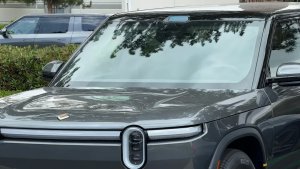
In a recent video interview, Rivian chief designer Jeff Hammoud walked through several hidden gems baked into the R2’s glass and bodywork. Among the most charming discoveries are a tiny Gear Guard Gary face on the windshield and a miniature rock climber ascending one of the rear windows.

Subtle Details for the Observant Owner

The "Gear Guard" character is Rivian’s quirky security mascot, and on the R2, he makes a very subtle appearance in the frit — the black dotted pattern along the edge of the windshield. Hammoud noted that this is one of his favorite additions because it is so easy to miss. "That one's one of my favorite ones ‘cause it's so subtle. That’s Gear Guard making a little appearance there. So, that's his smiley face, his eyes, and his mouth," Hammoud said.

If you look toward the rear of the vehicle, you might also spot a tiny decal of a mountain climber scaling the side window. Hammoud pointed this out as another nod to the brand's outdoorsy "adventure" identity.

Kim Java

These touches follow a long tradition of Rivian easter eggs, such as the Car Wash Mode and hidden Morse code messages in the infotainment system. Even the charge port door on the R2 has a maze molded into it to give you something to do while waiting for a top-up.

R2 Lineup and Launch Timeline

While the easter eggs are fun, the R2 itself is a serious path to profitability for Rivian. The company is currently finalizing the rollout for the different trims of the midsize SUV:

  • R2 Performance ($57,990): This is the first model off the line, slated for delivery later this spring. It features a 3.6-second 0–60 mph time, and the first orders will ship with an exclusive Launch Package.

  • R2 Premium ($53,990): Expected to follow in late 2026.

  • R2 Standard Long Range ($48,490): Coming in early 2027 as the range leader of the pack.

  • R2 Standard ($45,000): The much-anticipated, high-volume base model that’s expected in late 2027.

For a deep dive into how these versions stack up, you can check out our full R2 trim comparison.

Hammoud emphasized that he didn't want to "give them all away," suggesting that there are still plenty of hidden easter eggs waiting to be discovered under the hood of the R2 and throughout the cabin. As the first Launch Edition units start reaching customers in just a few months, we’ll likely see even more of these tiny details surface on social media. It is clear that Rivian wants the R2 to be a vehicle you keep exploring long after the new-car smell has faded.

Latest Rivian Update